


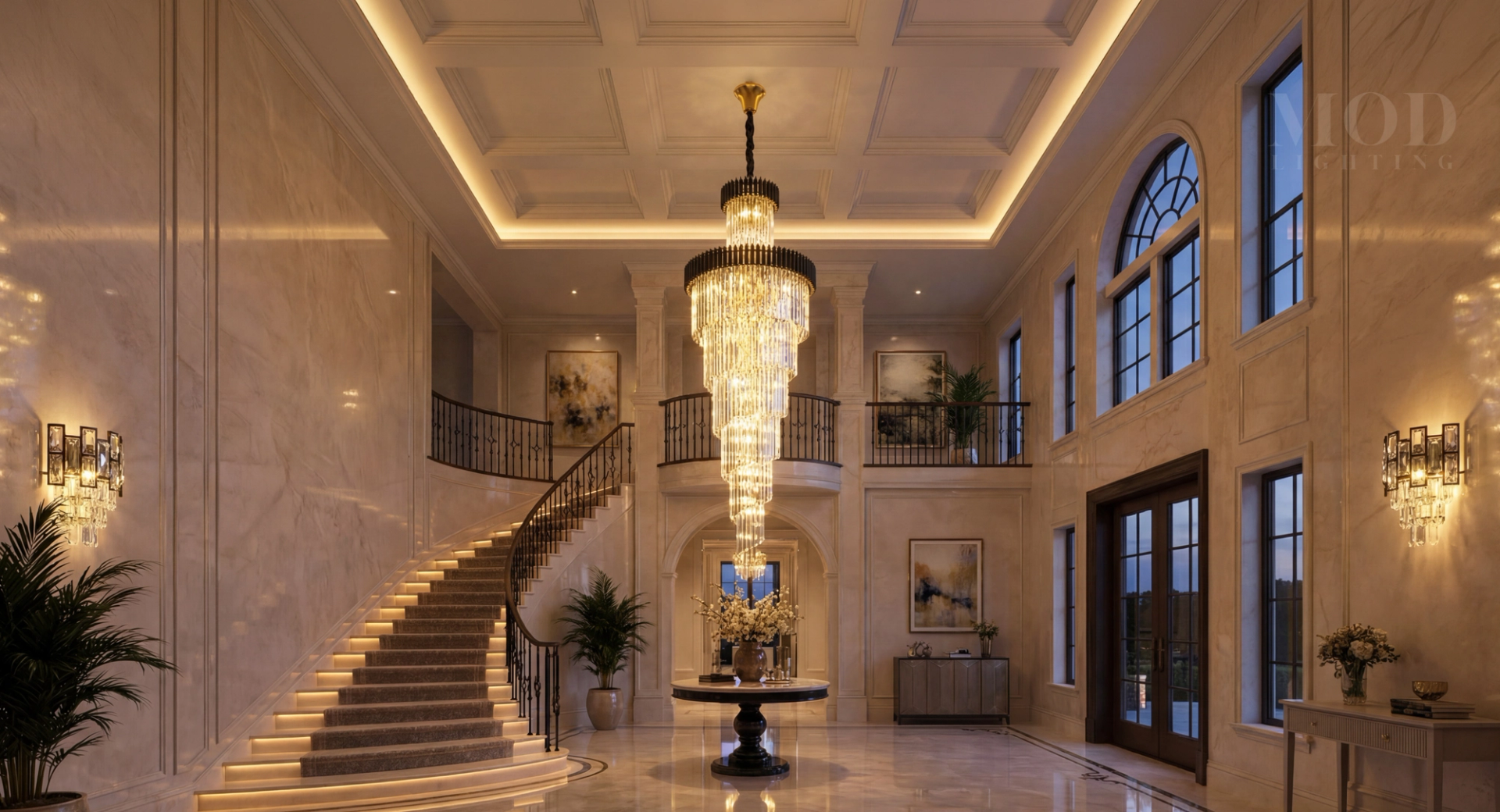
25 Entryway Lighting Ideas to Make a Stunning First Impression
Your entryway is the first thing guests see, and the first thing you feel when you arrive home. These 25 ideas show you how to light it beautifully.
WHO THIS IS FOR
- Homeowners redesigning or refreshing their entryway or foyer
- Anyone who wants to make a stronger first impression on visitors
- Homes with dark, narrow, or low-ceiling entryways needing a rethink
- Modern design lovers looking for a statement fixture above the door
- New homeowners planning their first lighting scheme from scratch
- Anyone replacing a builder-grade fitting with something that has real presence
KEY TAKEAWAYS
- Your entryway fixture is the first design statement visitors see, and it sets the tone for the entire home
- High ceilings deserve a dramatic chandelier or long-drop pendant; low ceilings need a flush or semi-flush fitting
- Warm white light (2700 to 3000K) creates the most welcoming first impression, so avoid cool white in an entryway
- Wall sconces can transform a narrow hallway by drawing the eye along the wall rather than down
- A statement fixture does not require a grand space. Even a small foyer benefits from one considered, beautiful piece
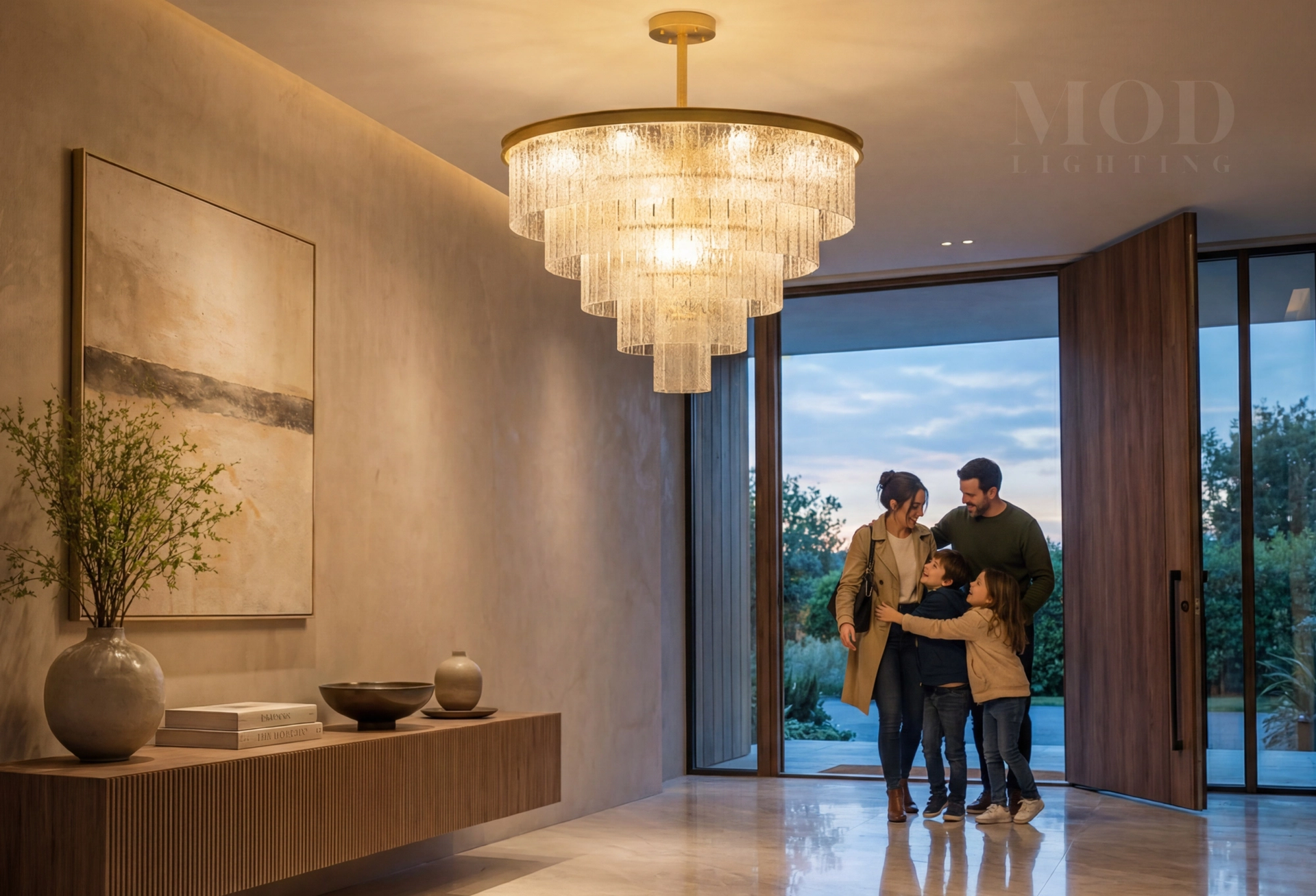
Your entryway is a threshold: the space between the world outside and the life you have built within. Before guests see the sofa, the artwork, the kitchen, they see the entry. And before anything else in the entry, they feel the light. A great entryway fixture does not just illuminate a space; it tells a story about the home that follows.
Whether you have a sweeping double-height foyer, a modest apartment hallway, or something in between, the right lighting transforms the experience of arrival. These 25 entryway lighting ideas cover every ceiling height, every footprint, and every design aesthetic, from grand crystal chandeliers to compact semi-flush fittings that prove restraint can be just as powerful as drama. Browse our entryway lighting collection whenever you are ready to shop.
What Makes Great Entryway Lighting? The Three Principles
Before choosing a fixture, understanding three things makes every other decision clearer. Great entryway lighting delivers on all three simultaneously.
Welcome: warmth and colour temperature
An entryway light must feel welcoming, and that means warm white light at 2700 to 3000K. Warm white creates an amber-tinted glow that reads as home, comfort, and arrival. Cool white (4000K+) creates the opposite: clinical, sharp, unwelcoming. If you have a dimmer, warm-white bulbs get even warmer as they dim, moving toward candlelight. That quality is exactly right for an entryway at evening.
Scale: fixture size relative to the space
An undersized fixture looks like an afterthought. An oversized one overwhelms. The reliable sizing rule: add the room’s length and width in feet, and that total in inches gives a good starting diameter. A 10 x 12-foot foyer suits a fixture around 22 inches wide. For ceiling height, hang the bottom of the fixture at least 7 feet above the floor, and add 3 inches of drop for every foot of ceiling above 8 feet.
Statement: the fixture as a design object
The entryway is the one room where a single fixture does all the work. There are no sofas, rugs, or art to share the visual load. The chandelier, pendant, or sconce in an entryway carries the room’s personality on its own. Choose it with the same care you would give a piece of art: for its form, its material, its character, not just its light output.
Modern Entryway Lighting Ideas
Modern entryway lighting ranges from the near-invisible restraint of a minimal brass ring to the graphic precision of a geometric black frame. What unites every strong choice is intention: each design decision is visible, and every material choice is honest. Browse our full entryway lighting collection for contemporary options.

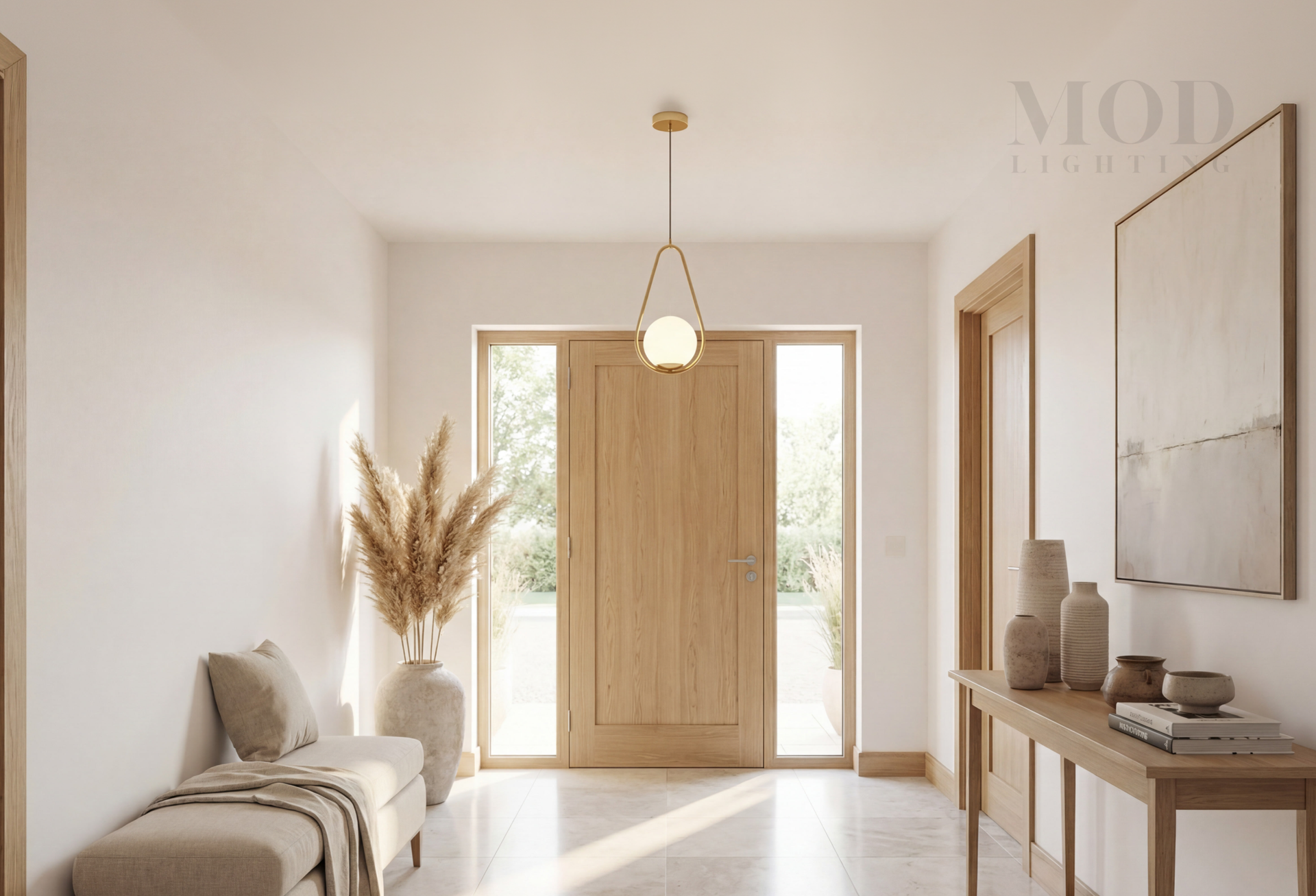
The minimal brass pendant: understated elegance
A single brushed brass pendant in a clean-lined foyer is one of the most reliably beautiful entryway choices available. The material adds warmth without drama; the form is simple enough to complement any palette. It works best in Scandi and Japandi-influenced homes where the brief is warmth with restraint. Hang it slightly lower than feels instinctive, around 7 feet above the floor, and pair with a warm filament bulb.
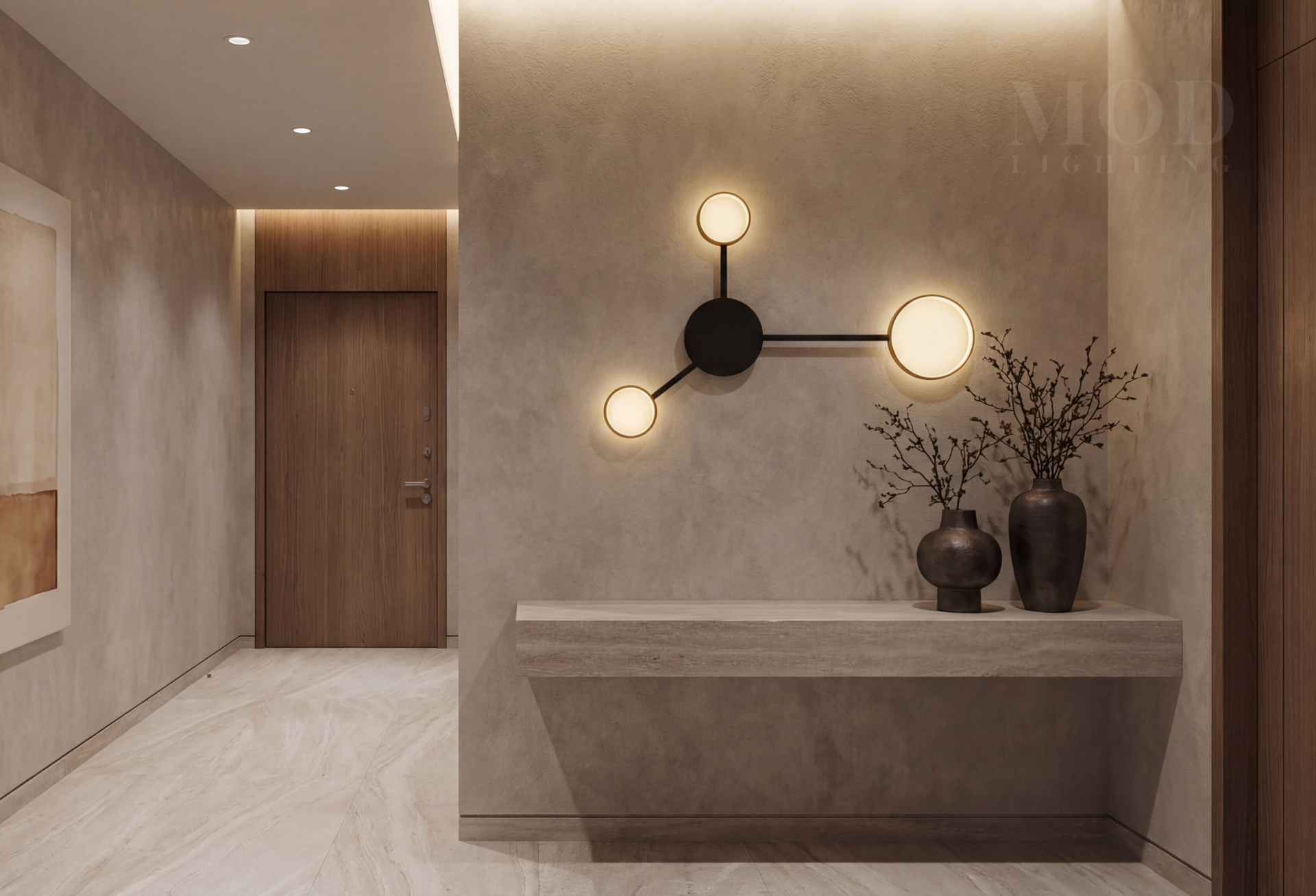
Geometric black iron: graphic and architectural
A geometric frame in matte black delivers graphic precision that suits contemporary and industrial-modern homes. The dark finish reads lighter than it physically is, and the angular form creates a strong visual statement without needing scale. This works particularly well in homes where the architecture is already doing design work: exposed brick, polished concrete, or strong structural elements.
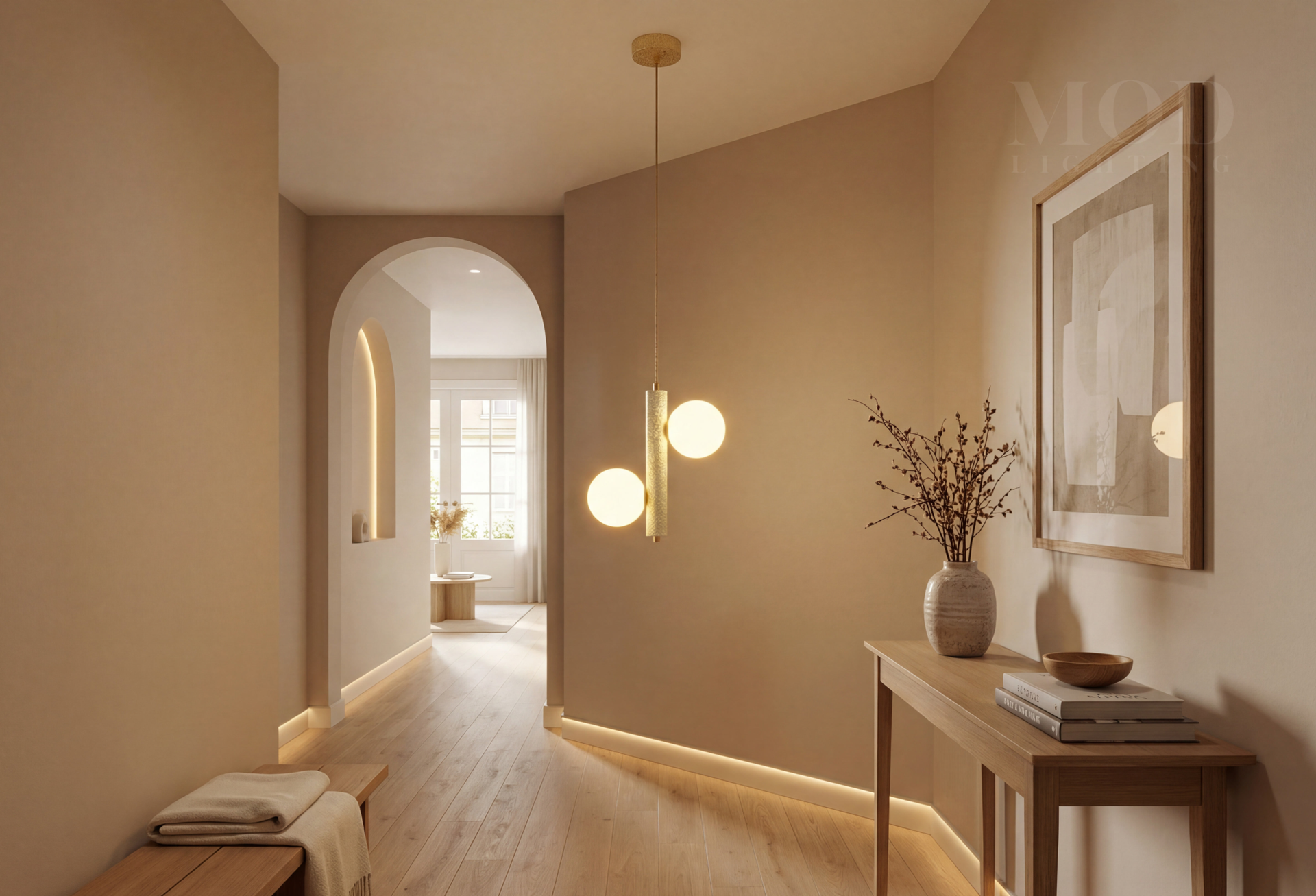
Sculptural statement: a single dramatic form
In a foyer where the fixture is the only object at ceiling level, choose a design that earns the attention. Organic, branching, or asymmetric forms work particularly well here because they read as art objects first and light sources second. The rest of the entry should stay calm: pale walls, simple flooring, no competing visual noise.
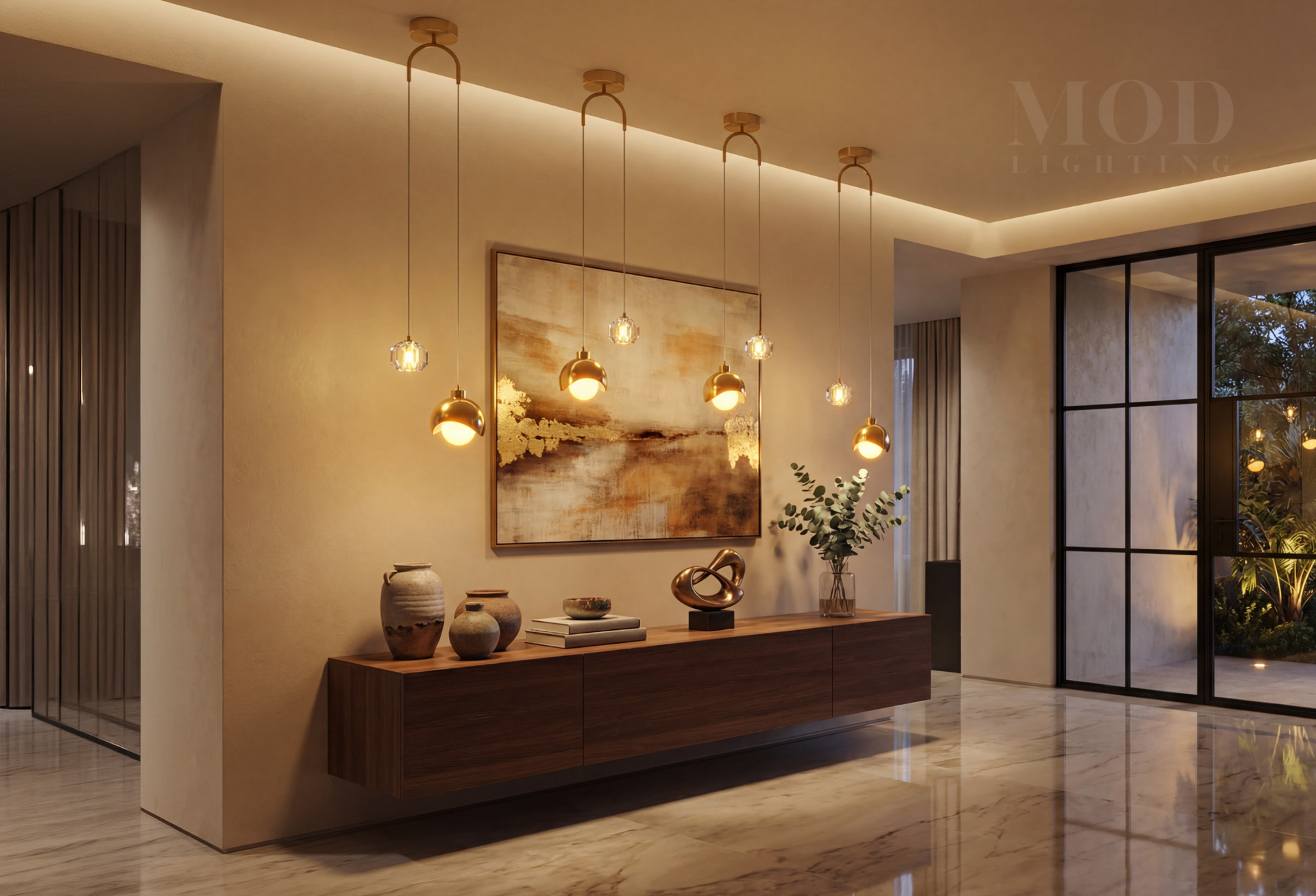
Warm pendant cluster: organic and inviting
A cluster of pendants at varying heights creates a canopy of warm light above the entry, intimate and inviting in a way a single fixture rarely achieves. Vary the drop lengths significantly for visual interest: the lowest pendant should hang around 7 feet above the floor, with others at 7.5 and 8.5 feet. Use matching pendants for coherence; mixing shapes creates visual clutter.
Crystal updated: luxury without formality
Today’s crystal entryway fixtures bear little resemblance to their traditional predecessors. Crystal elements set within contemporary structures (minimal frames, asymmetric drops, geometric brackets) deliver the prismatic light and luxury of crystal without historical formality. In a bright foyer, daytime sunlight activates the crystals and fills the space with animated light. Browse crystal options in our modern chandelier collection.
Statement Chandeliers for Grand Entryways and Double-Height Foyers
A double-height foyer is one of the rarest opportunities in residential lighting design. Most rooms do not have the vertical space to accommodate a fixture with real drama. The grand foyer does, and the only mistake is under-using it. Read our modern chandelier ideas guide for deeper inspiration, and explore the modern chandelier collection for designs built for scale.
The biggest mistake in a double-height foyer isn’t going too large — it’s leaving that vertical space unfilled.
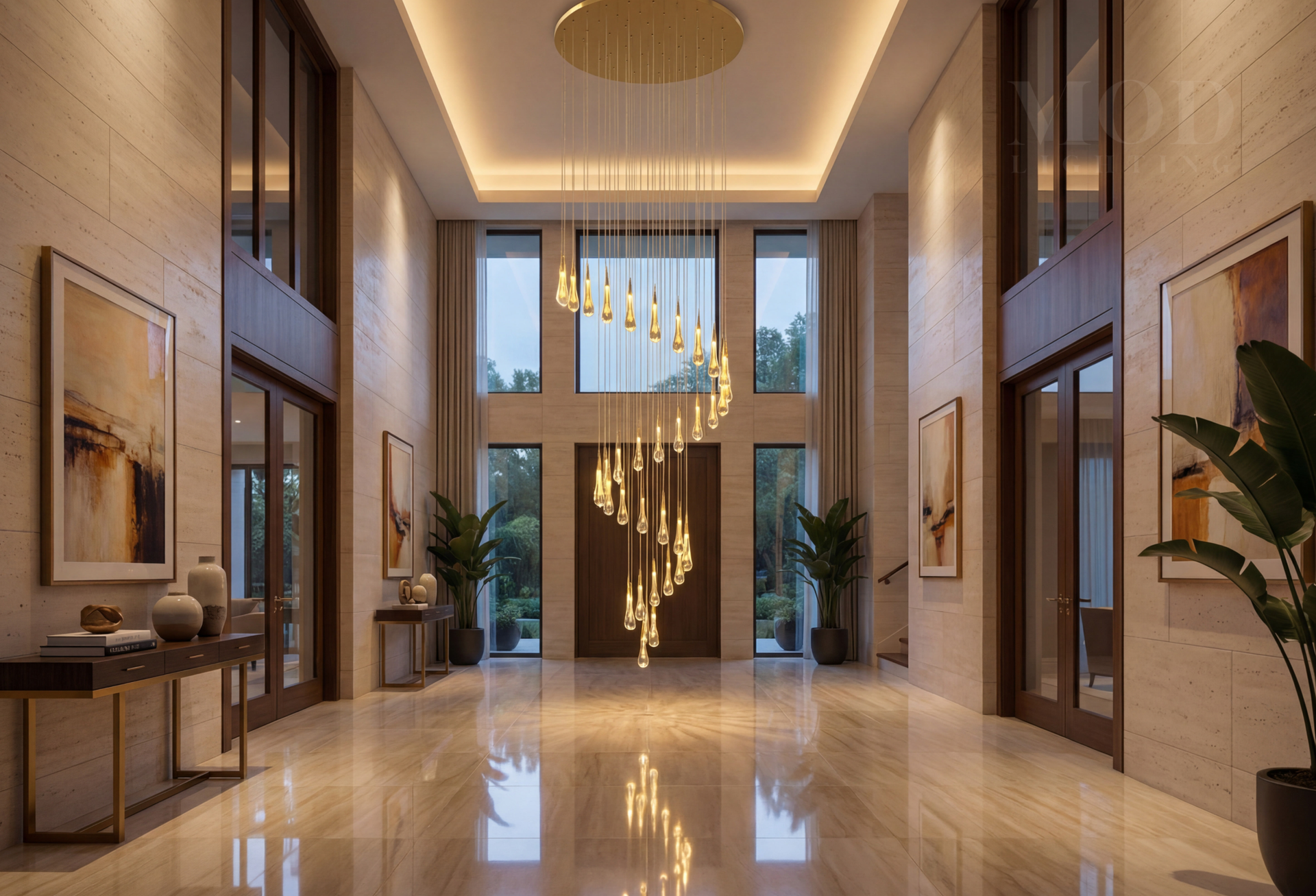
The cascading crystal drop
A cascading crystal chandelier, with multiple tiers or individual elements suspended at varying depths, fills a double-height foyer in a way no other fixture can. The key is letting it drop: the bottom of the fixture should hang to around 8 or 9 feet above the floor even in a 16-foot-ceiling space, creating a visual connection between the architectural height and the human experience below. Indra, with its adjustable individual crystal droplets, is particularly well suited to this format.
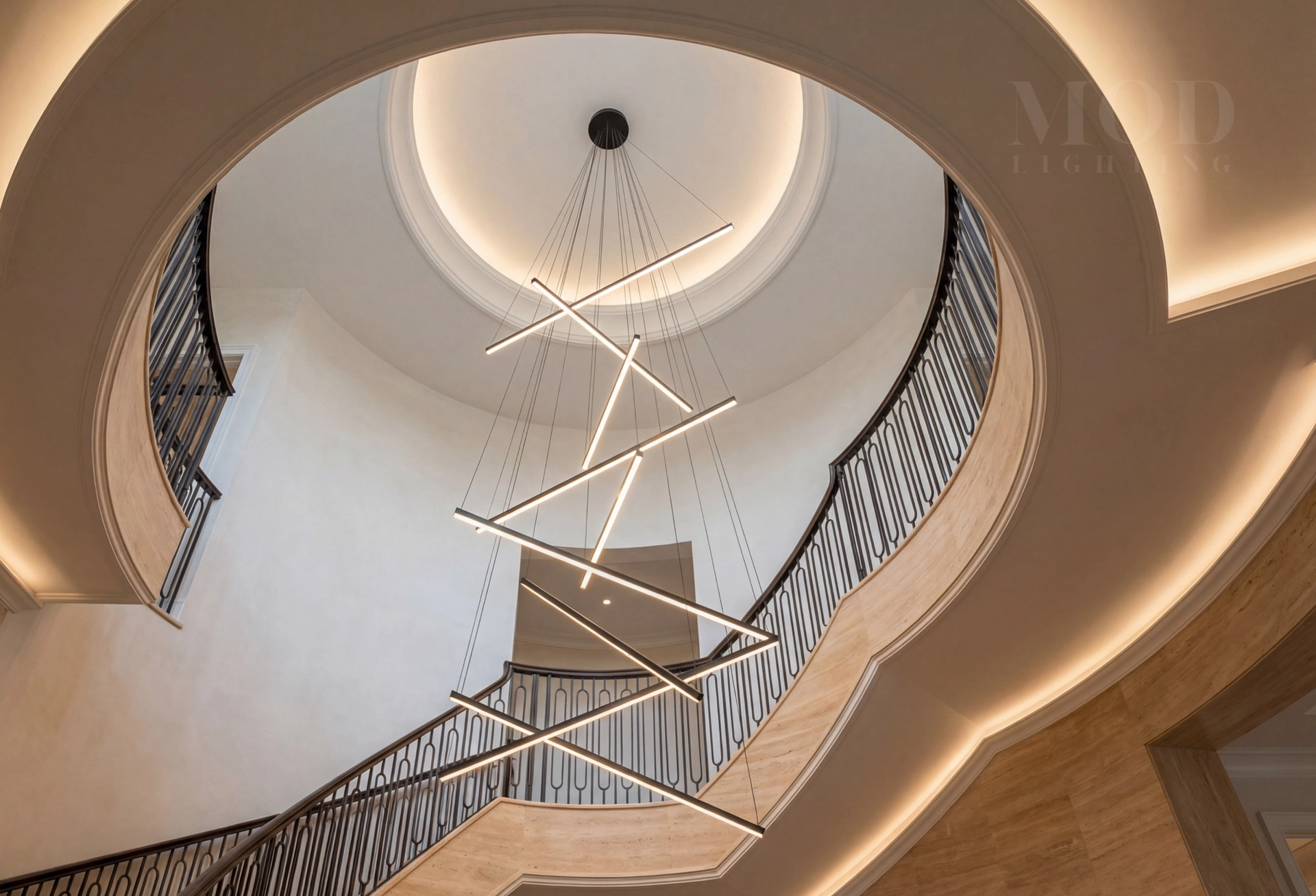
The oversized geometric frame
A large geometric chandelier (a multi-sided frame, a bold angular structure) uses the foyer’s height to create a genuine architectural event. Viewed from below, the geometric form reveals layers of structure and shadow that a smaller fixture in a standard room could never achieve. Choose a diameter proportional to the floor footprint: for a 12 x 14-foot foyer with a 14-foot ceiling, look for a fixture 28 to 32 inches wide.
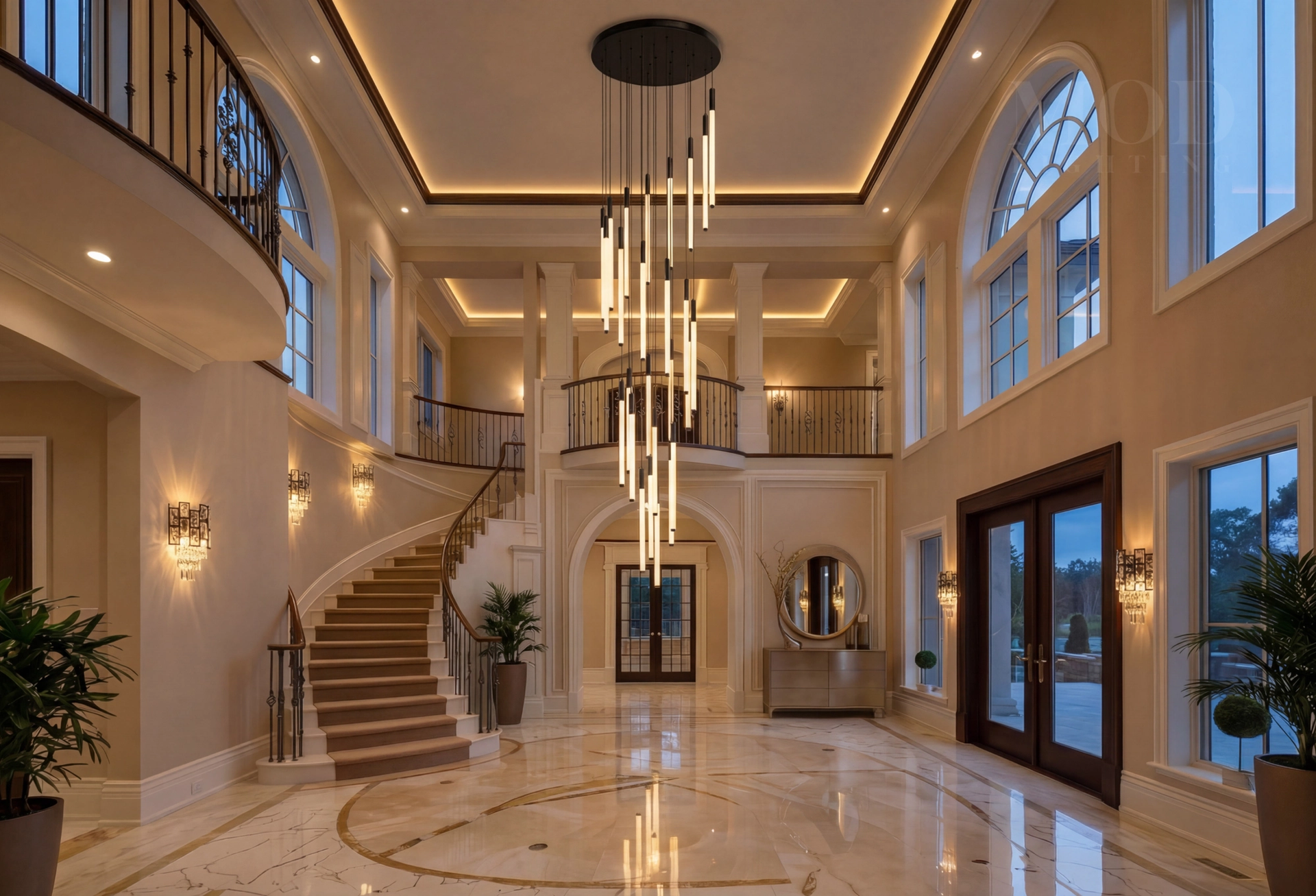
The sculptural organic form
Organic branching forms, fixtures that reference natural structures without illustrating them literally, create a foyer presence that is genuinely memorable. These are the chandeliers guests remember. In a grand entry, the branching structure fills horizontal space while the drop fills vertical space, giving the fixture presence on every axis simultaneously.
Small Entryway Lighting Ideas That Punch Above Their Scale
A compact foyer or narrow hallway does not disqualify beautiful lighting. It demands smarter choices. The goal is a fixture with genuine visual character in a compact footprint: one that communicates intention rather than limitation.
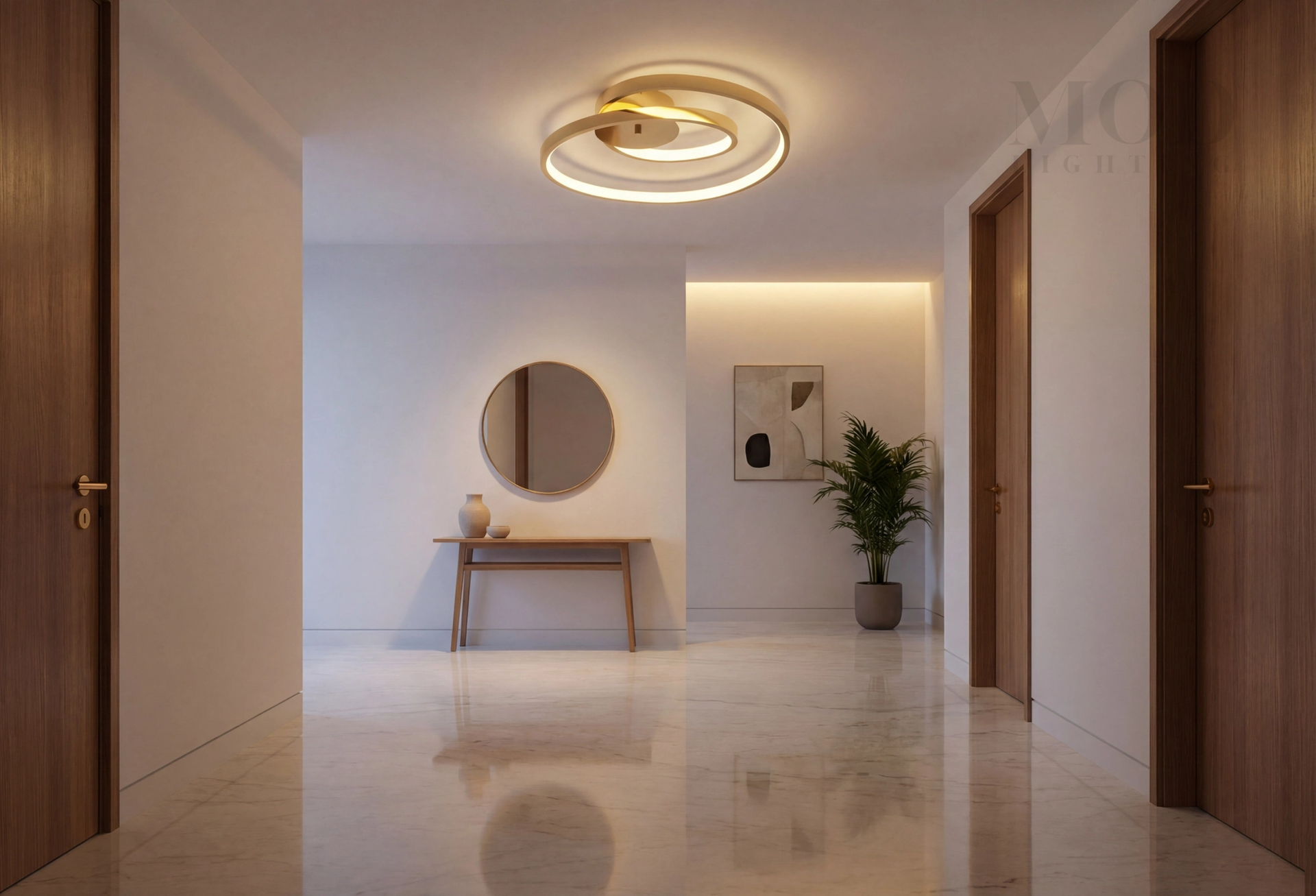
Semi-flush fittings with real presence
Semi-flush fittings have earned serious design credentials. Many now feature textured glass, multi-arm formats, and material combinations that deliver chandelier-level visual interest without any drop clearance concern. For a ceiling below 8 feet in a compact foyer, this is the correct category. Browse modern options in our ceiling lights collection.
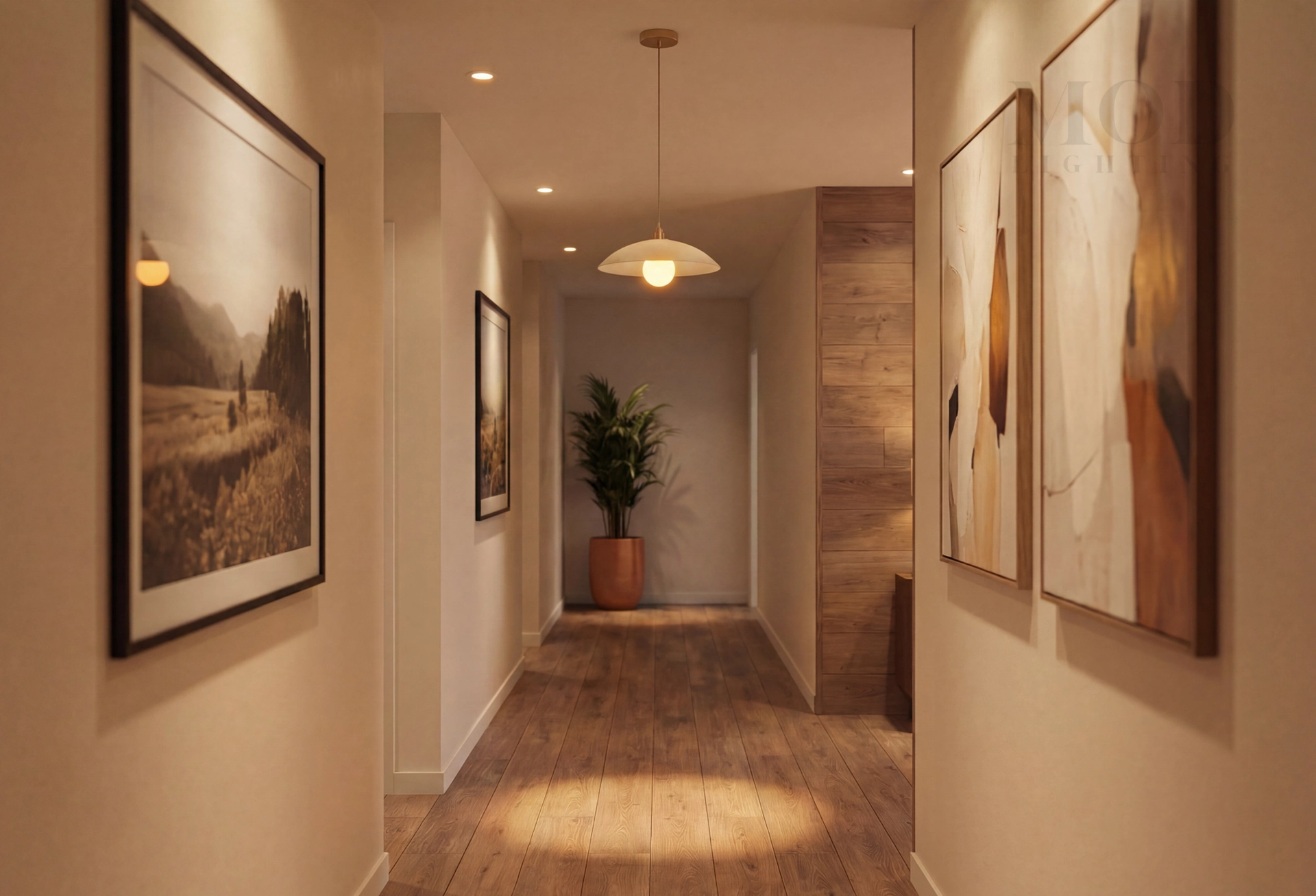
A single bold pendant in a small space
A small space with one confident, well-chosen pendant reads as more considered than a large space with the wrong fixture. In a narrow hallway, a single pendant with strong form (a dark geometric frame, a sculptural ceramic shade, a compact crystal form) creates the experience of arrival without crowding. Keep the pendant as high as clearance allows, and choose a shade that diffuses light softly rather than casting direct beams.
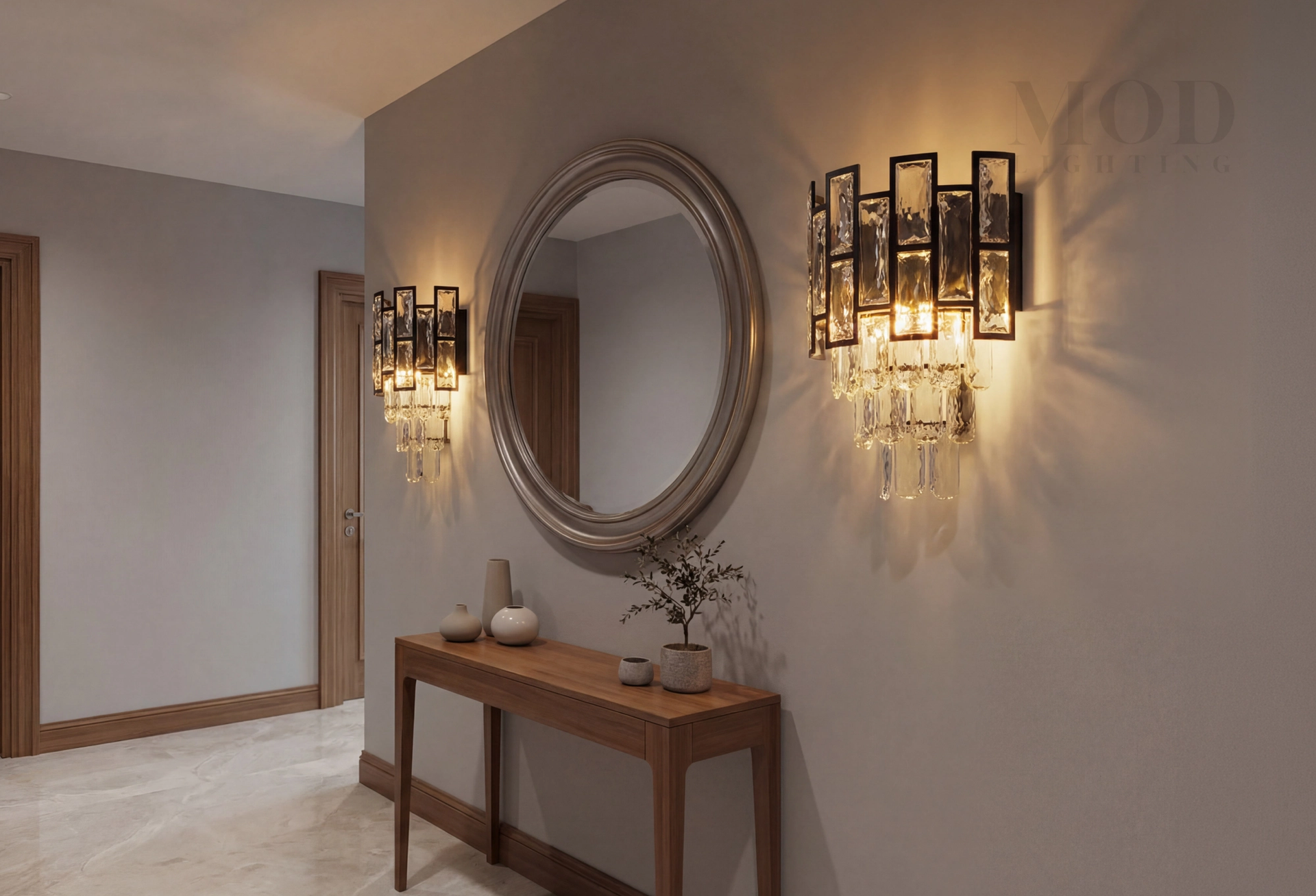
Wall sconces as the primary light source
In very compact or low-ceiling entryways, wall sconces can replace the ceiling fixture entirely. A pair flanking a mirror creates warmth, depth, and the illusion of greater width simultaneously. The light bounces off the mirror and fills the space more generously than an overhead source alone. Browse wall sconce options in our wall lights collection.
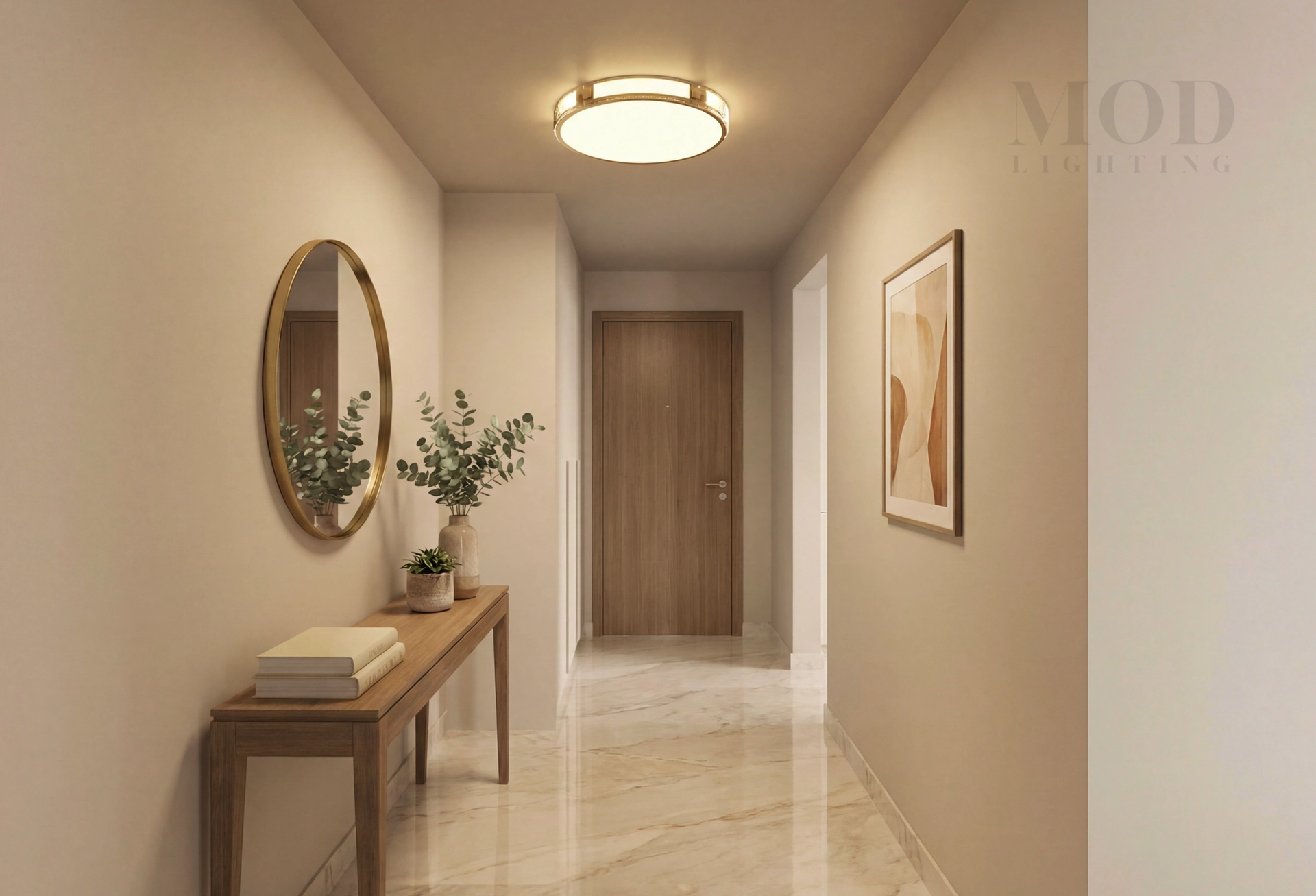
Flush Mount Lighting for Lower Ceilings
Flush mount lighting has undergone a design renaissance. Where once it meant a functional white bowl, today’s flush mounts include ribbed glass designs, woven natural material shades, multi-arm formats, and metallic constructions that are genuinely beautiful at ceiling level. If your entryway ceiling is below 8 feet, a flush mount is not a compromise. It is the correct design choice, and there are excellent options that deliver real visual character.
The key is choosing a design with interesting surface texture or material quality that earns attention from below. A ribbed glass flush mount catches light differently at different times of day; a woven rattan design adds organic warmth to a minimal entry. Browse our ceiling lights collection for flush and semi-flush designs worth considering.
Using Wall Sconces to Transform Your Entryway
Wall sconces are the most underused tool in entryway design. Most homeowners consider a ceiling fixture and nothing else, which means adding even a single pair of sconces transforms the atmosphere completely. They draw the eye to the walls, create pools of warm light at human height, and add a layer of depth that overhead lighting cannot replicate alone.
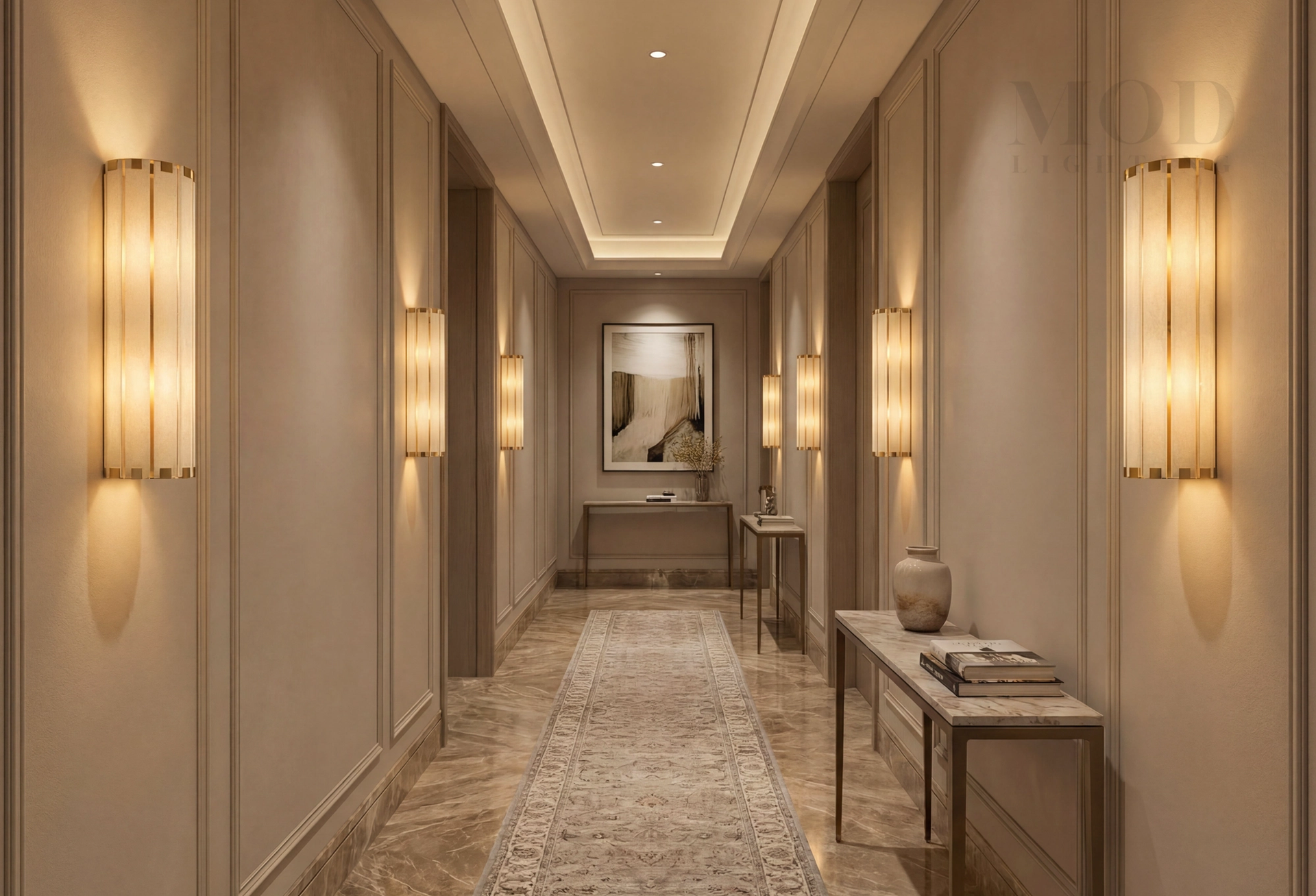
Flanking a mirror: the arrangement that always works
A pair of wall sconces on either side of a mirror is one of the most reliably beautiful arrangements in entryway design. The mirror amplifies the light, creating visual width and warmth simultaneously. Choose sconces that direct light upward or outward, not downward, for the most flattering and welcoming effect.
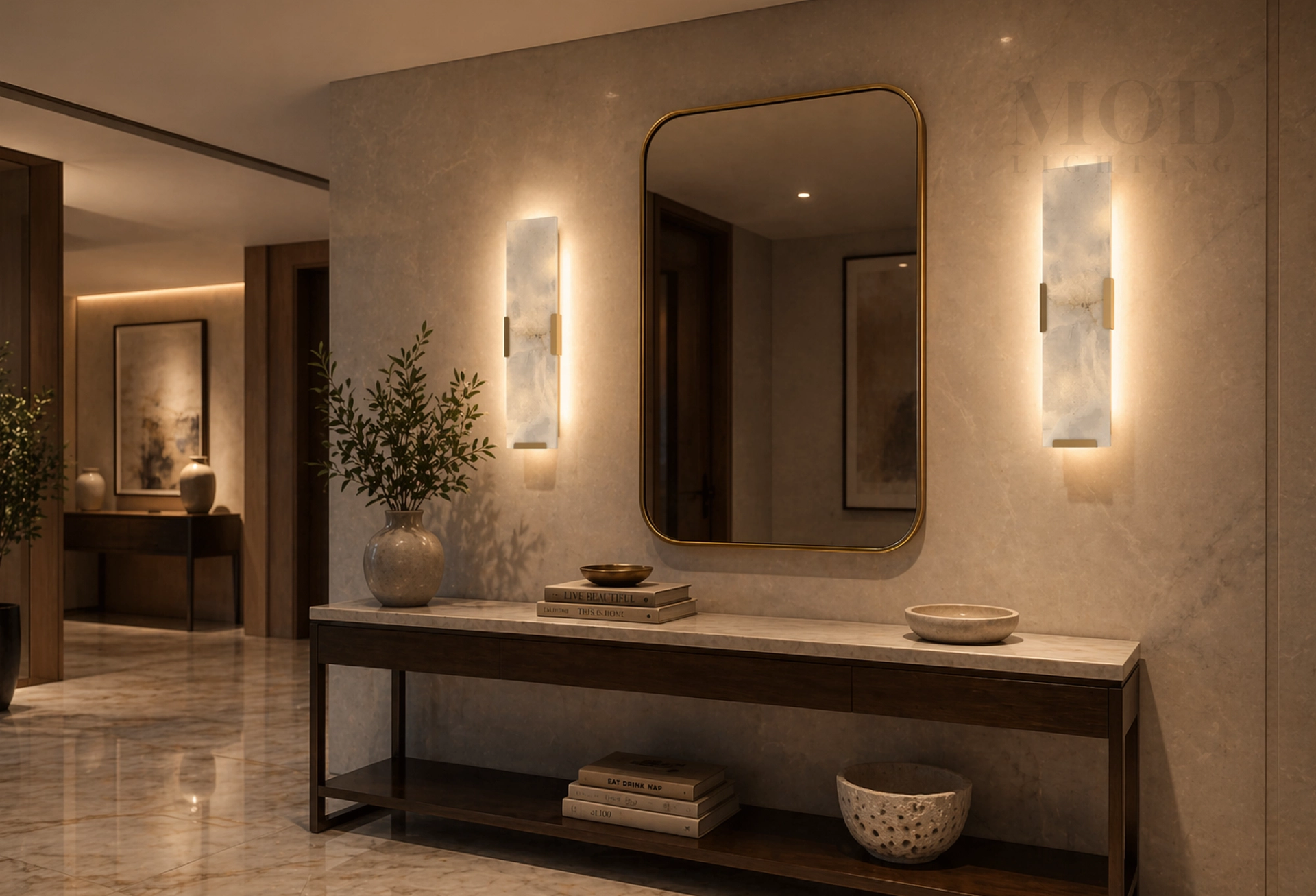
Lining a longer hallway
In a longer entry hall, sconces spaced at regular intervals along one or both walls create a sense of occasion. Each sconce creates a pool of warm light that draws the eye forward, making the hallway feel like a deliberate journey rather than a functional necessity.
As the sole light source
In a narrow hallway where ceiling clearance is limited, two well-chosen sconces can be the only light source, and they can be the right choice. They free up the visual ceiling plane, making the space feel less confined, while providing adequate ambient light for a transitional space. Browse all options in our wall lights collection.
How Lighting Can Make a Dark or Narrow Entryway Feel Bigger
Lighting is the most powerful tool available for changing how a space feels without changing its physical dimensions. In a dark or narrow entryway, the right approach makes an immediate and significant difference.
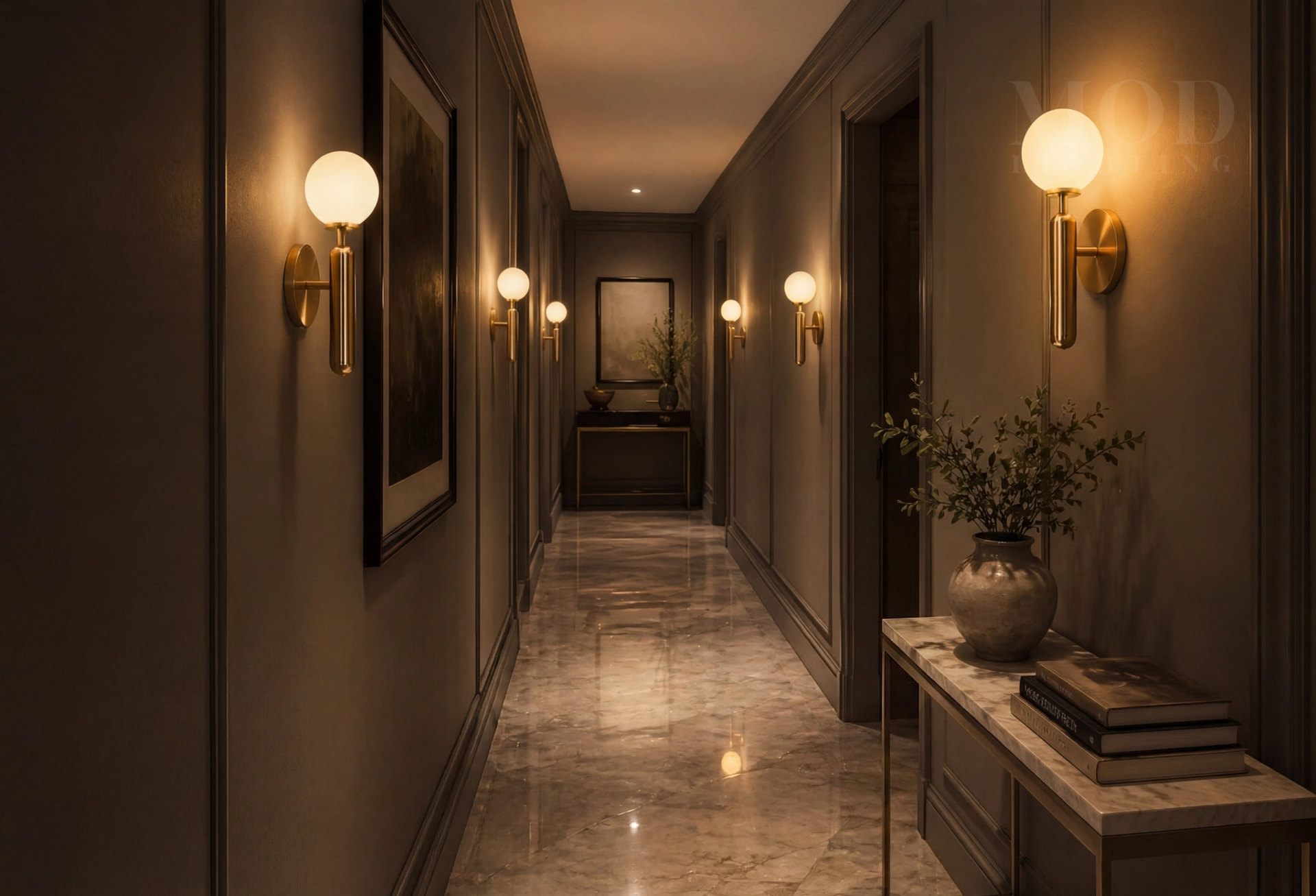
Use wall sconces rather than relying on a single overhead source. Sconces draw light along the walls, creating visual width rather than just overhead illumination. The walls feel further apart when they are lit.
Position a mirror opposite a light source. This doubles the apparent depth of the space and bounces warm light throughout. Even a narrow foyer feels generous with a well-placed mirror and the right sconce.
Choose warm-white bulbs and maximise brightness within that warmth. A dark entryway lit with warm, bright light feels welcoming. The same space lit with dim or cool light feels claustrophobic.
Use vertical elements to draw the eye upward. A tall sconce, a long-drop pendant, or even a tall console table creates the impression of height. When the eye moves up, the ceiling feels further away.
Warm vs Cool Light: Why Entryways Always Need Warmth
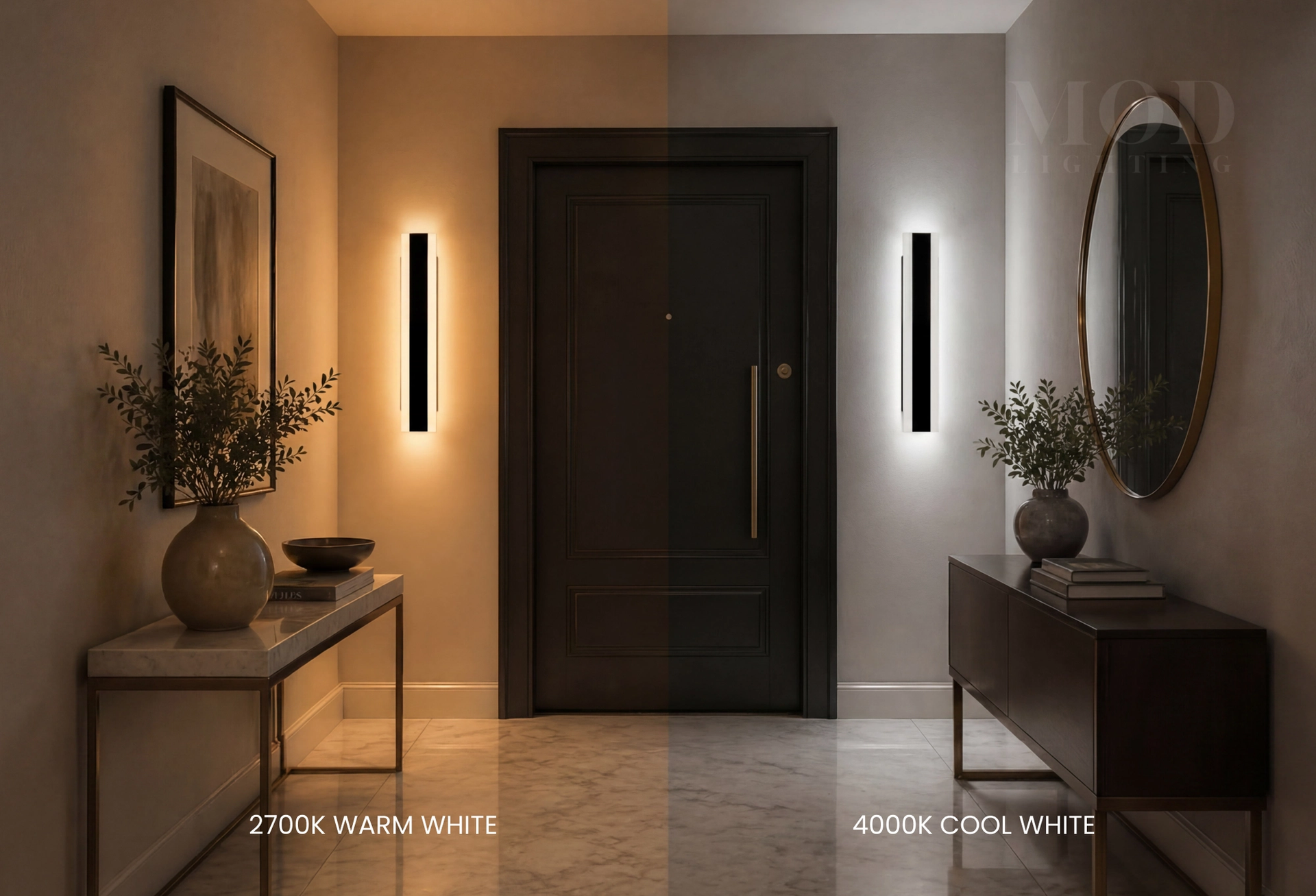
Warm white (2700 to 3000K) is the non-negotiable choice for an entryway — it produces an amber-tinted light that reads as welcoming, domestic, and warm, the visual equivalent of a fire in the hearth. Guests feel it the moment they step inside.
Cool white (4000K+) belongs in kitchens, bathrooms, and home offices where clarity matters more than atmosphere. In an entryway, cool light creates an unwelcoming, almost clinical impression — the opposite of what a home entry should communicate.
The colour temperature of your entryway light is a feeling, not just a specification. Choose warmth every time.
Matching Your Entryway Lighting to Your Interior Style
The entryway fixture is the first note of a longer design composition. It should share the aesthetic language of the rooms beyond it, not match them literally, but speak the same visual vocabulary. See how lighting flows through the home in our living room lighting ideas guide.
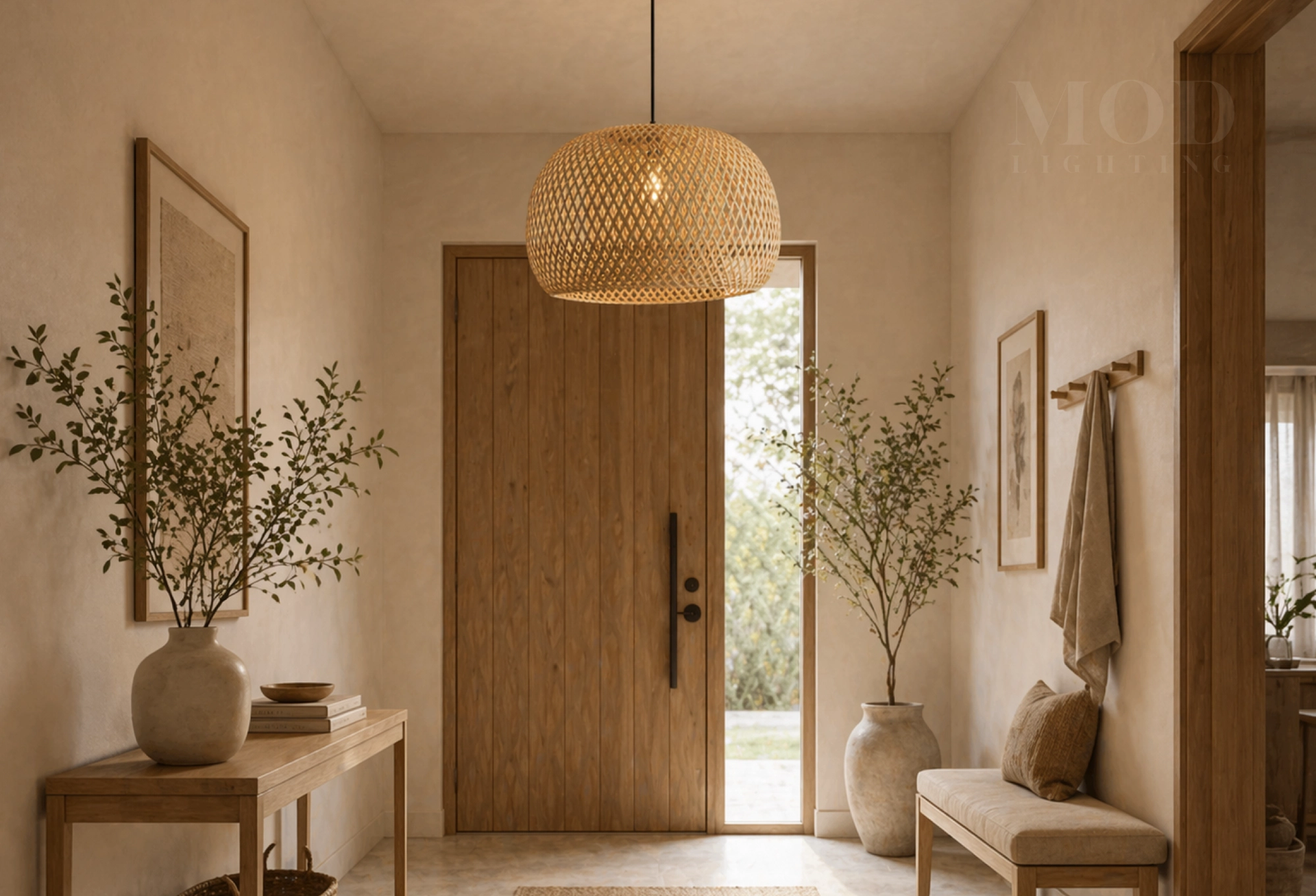
Scandi and Japandi: restraint and natural materials
Choose simple forms in honest materials: brushed brass, natural wood, linen shades. A single pendant with a diffusing shade in a clean-lined foyer delivers warmth without visual noise. Avoid ornamentation; the beauty comes from material quality and proportion.
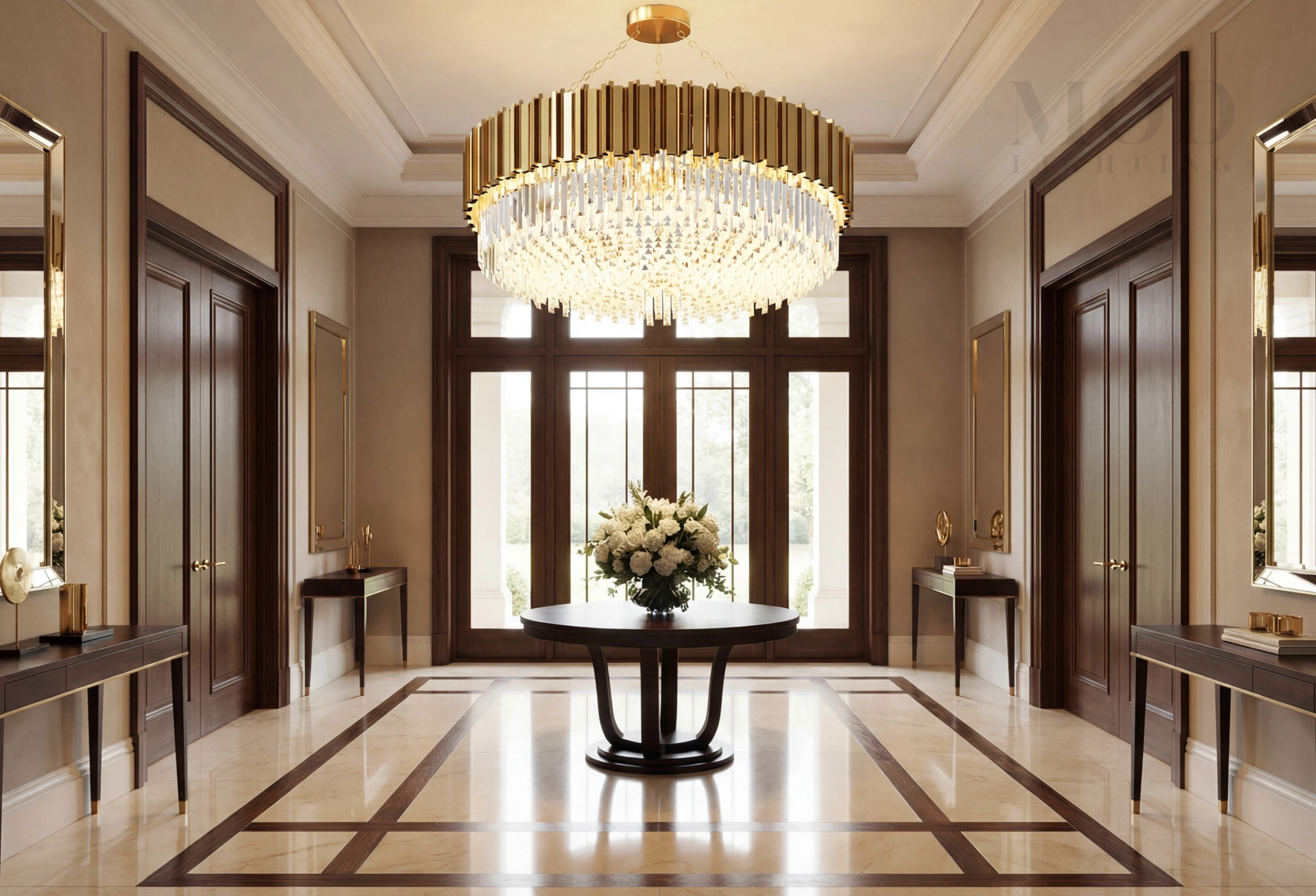
Contemporary luxe: gold, crystal, and drama
A gold or brass chandelier with crystal elements creates instant luxury in a contemporary entryway. Choose a design with a contemporary structure (clean geometry or a sculptural form) to keep the look current rather than traditional. Celestial, Athena, and Indra from the MOD range are all strong choices. Browse them in our modern chandelier collection.
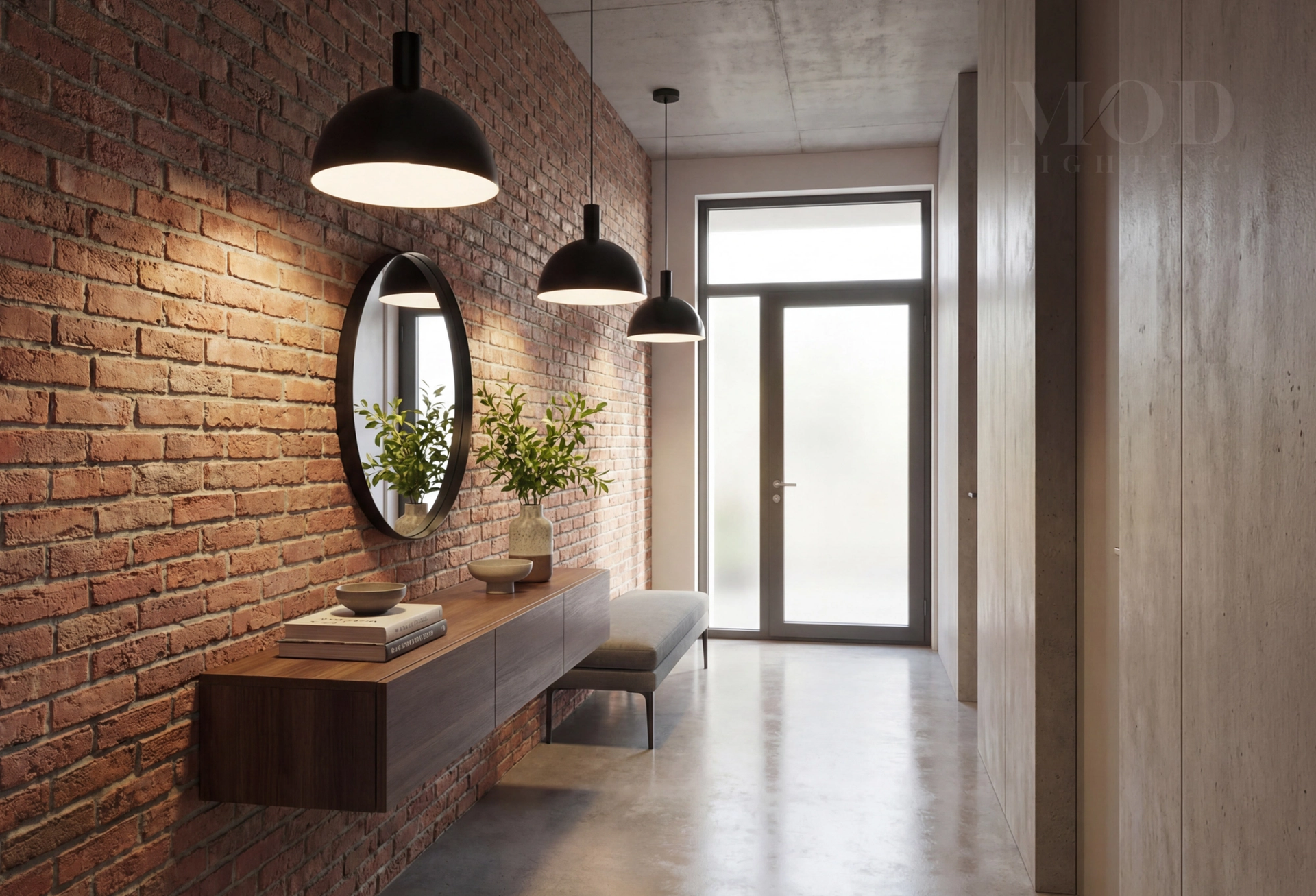
Industrial modern: black metal and exposed form
Matte black fixtures (geometric frames, exposed cable, bare bulb) suit homes with industrial or urban design sensibilities. The dark finish reads graphic against white or light walls, and the exposed form honours the industrial tradition of honesty about materials and structure.
Classic-modern: timeless shapes with updated finishes
Candelabra-style fixtures in a modern black or brushed brass finish, or traditional crystal chandeliers given a contemporary structural update, suit transitional homes beautifully. The form references history; the finish keeps it current. Kendall from the MOD range is a strong example: a candelabra design that reads contemporary rather than period.
Your Entryway Is Waiting for Its Moment
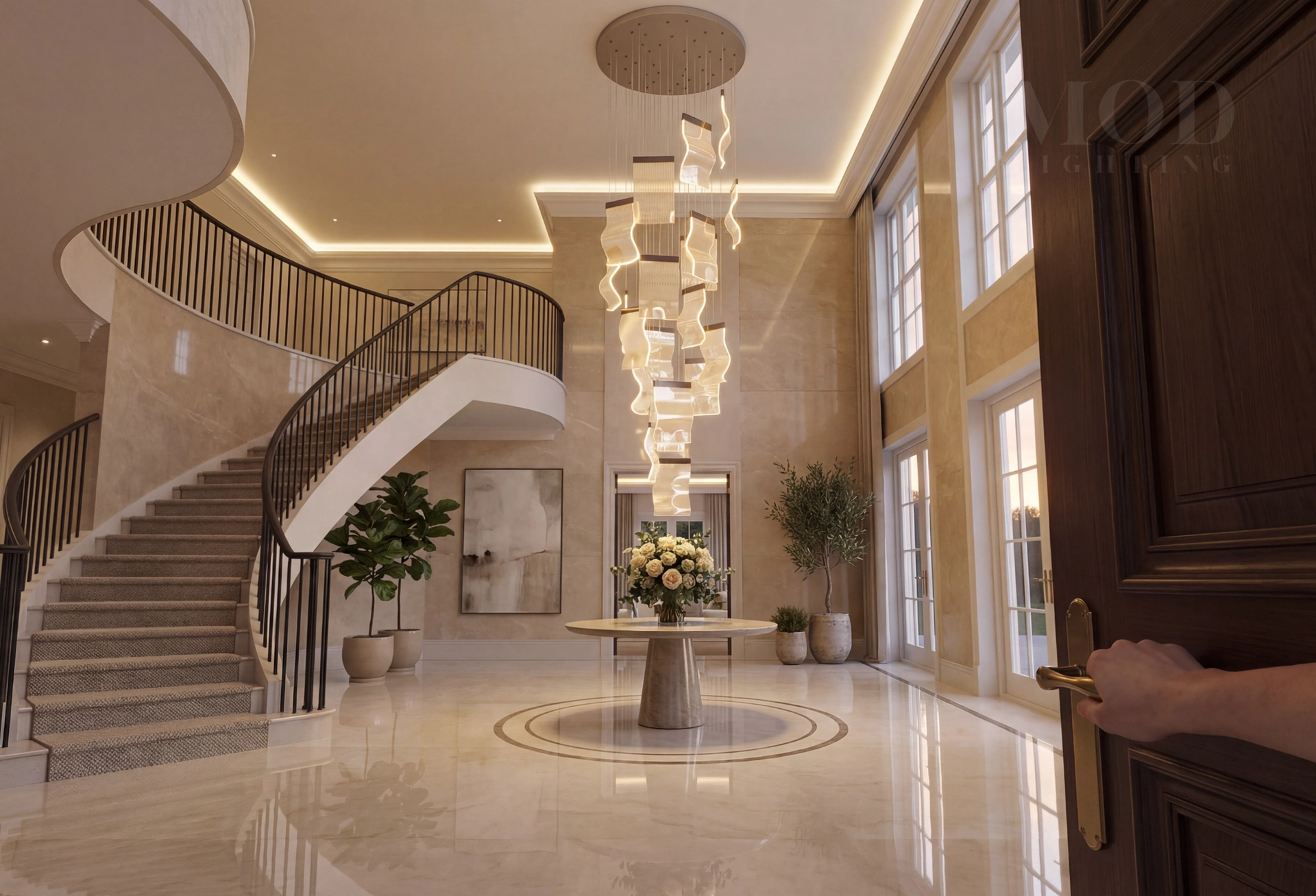
The right entryway fixture changes the experience of arriving home — not just for guests, but for you, every single day. It is the last thing you see when you leave and the first thing you feel when you return. Few lighting decisions have a more direct impact on how a home feels to live in.
Browse our full entryway lighting collection to find the fixture that makes your arrival something worth looking forward to. Or explore our modern chandelier collection for statement designs built for grand and dramatic foyers.
Frequently Asked Questions
The best entryway lighting combines a statement overhead fixture (chandelier, pendant, or semi-flush) with warm white bulbs at 2700 to 3000K. In larger foyers, add wall sconces for depth — the fixture should be proportional to the ceiling height and strong enough as a design object to set the tone for the whole home.
Always warm. Warm white (2700 to 3000K) creates the welcoming atmosphere that makes people feel at home the moment they walk in. Cool white (4000K+) is clinical and unwelcoming in a domestic entryway. If you have a dimmer, warm-white bulbs get even warmer as they dim, which is exactly the right quality for an entry.
Yes. The key is choosing a compact design with genuine visual presence. A chandelier 18 to 22 inches in diameter can anchor a small foyer beautifully. Choose a design with strong visual character so it earns its place without overwhelming the space.
Aim for 50 to 80 lumens per square foot. A 10 x 10-foot foyer needs around 500 to 800 lumens: enough to see clearly and feel welcome, but not so bright it feels like a commercial space. Always use a dimmer so you can adjust the atmosphere.
Add the room’s length and width in feet, and that total in inches is a reliable starting diameter. A 10 x 12-foot foyer suits a fixture around 22 inches wide. Hang the bottom at least 7 feet above the floor, plus 3 inches of drop per foot of ceiling above 8 feet.
Use wall sconces to draw light along the walls rather than just down from the ceiling. Position a mirror opposite a light source to bounce light through the space. Choose warm-white bulbs, maximise brightness, and use vertical elements to draw the eye upward and create the impression of height.
Choose a chandelier with genuine scale and drop length — a branching form, cascading crystal, or oversized geometric frame. Add 3 inches of drop for every foot of ceiling above 8 feet to fill the vertical space intentionally. A fixture that feels large in a showroom will look exactly right once it is hanging in a double-height room.
Yes. A dimmer transforms an entryway fixture from functional to atmospheric. Full brightness for daytime; lower, warmer light for evenings when the home should feel like a sanctuary. Ensure your dimmer is LED-compatible and that your bulb or LED strip is dimmable.